Group Project
My Role: Project Manager, product designer
Duration: 3 months
Tool: Figma, Miro
Tags: UI/UX Design, App Design, Research, Usability Test, Prototype
Group Project
My Role: Project Manager, product designer
Duration: 3 months
Tool: Figma, Miro
Tags: UI/UX Design, App Design, Research, Usability Test, Prototype
Group Project
My Role: Project Manager, product designer
Duration: 3 months
Tool: Figma, Miro
Tags: UI/UX Design, App Design, Research, Usability Test, Prototype
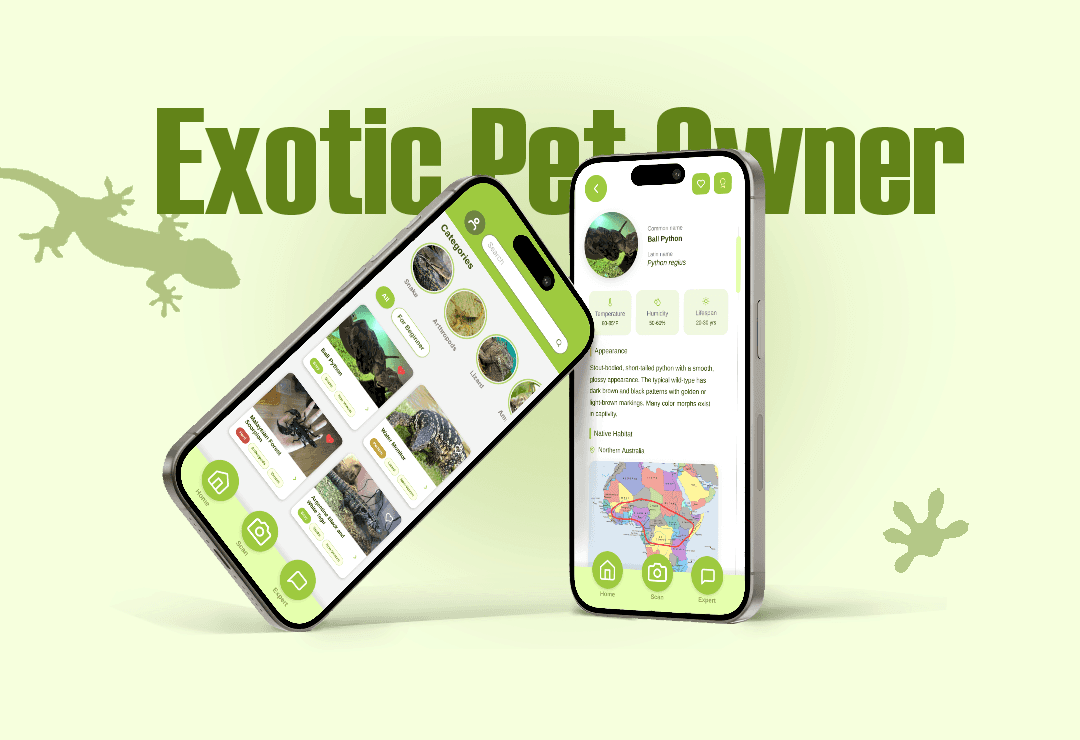
Exotic Pet Owner
Exotic Pet Owner
Exotic Pet Owner
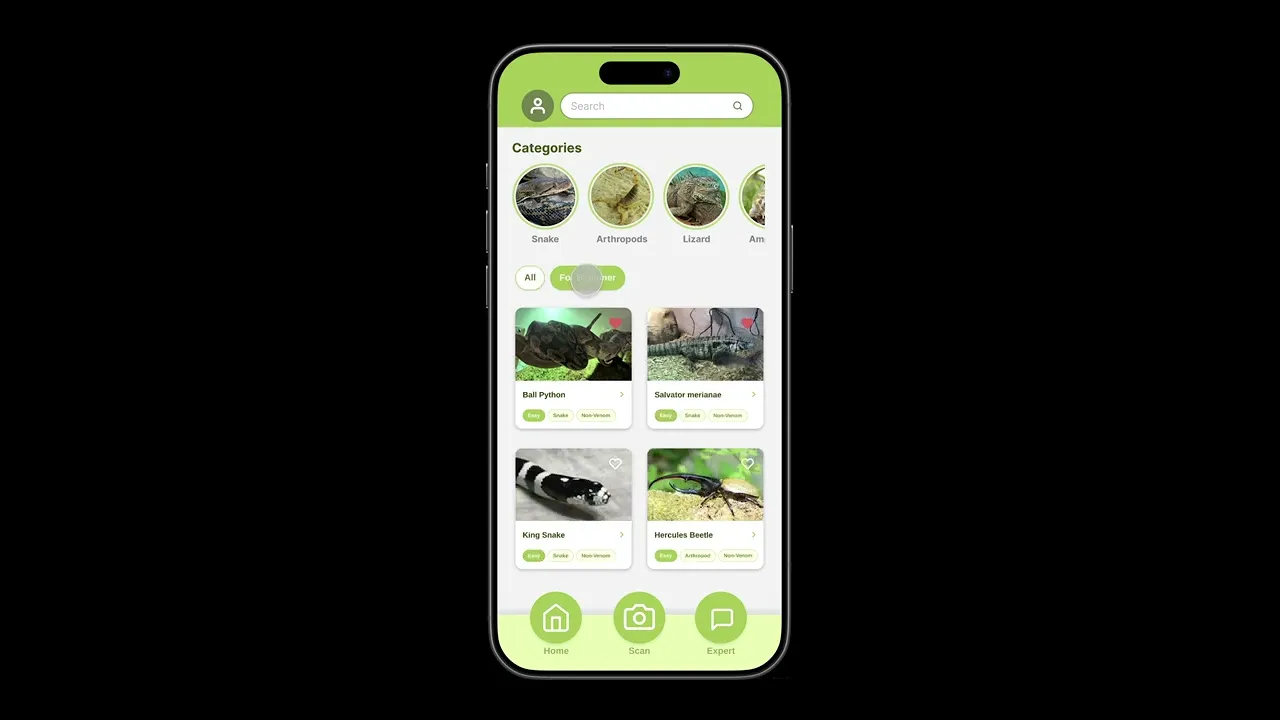
An all-in-one app combining AI identification, expert consultation, and simplified health tracking. We help beginners navigate conflicting advice and complex terminology to raise happy, healthy pets.
An all-in-one app combining AI identification, expert consultation, and simplified health tracking. We help beginners navigate conflicting advice and complex terminology to raise happy, healthy pets.
An all-in-one app combining AI identification, expert consultation, and simplified health tracking. We help beginners navigate conflicting advice and complex terminology to raise happy, healthy pets.
My Contributions:
My Contributions:
My Contributions:
Led planning and facilitated team collaboration to ensure timely delivery.
Defined product strategy, user flows, and information architecture.
Conducted user research & usability testing.
Designed the High-fidelity prototype.
Iterated design based on usability evidence
Led planning and facilitated team collaboration to ensure timely delivery.
Defined product strategy, user flows, and information architecture.
Conducted user research & usability testing.
Designed the High-fidelity prototype.
Iterated design based on usability evidence
Led planning and facilitated team collaboration to ensure timely delivery.
Defined product strategy, user flows, and information architecture.
Conducted user research & usability testing.
Designed the High-fidelity prototype.
Iterated design based on usability evidence
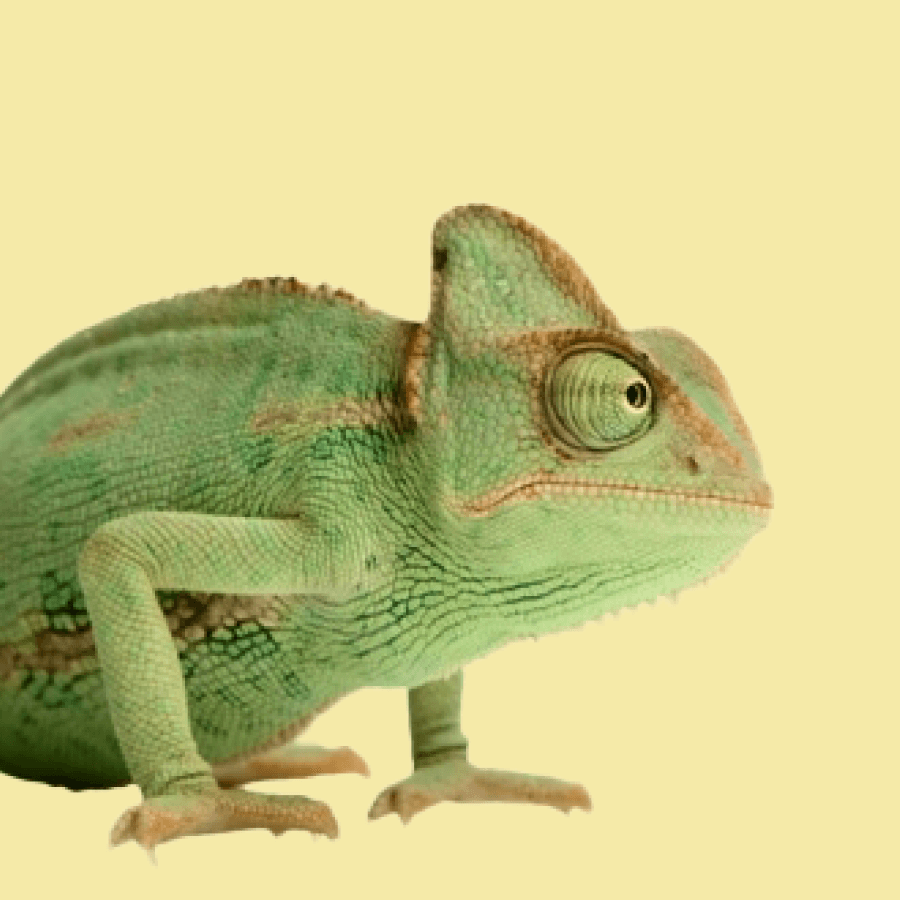
In our app, you can
In our app, you can
In our app, you can
Scan your pet
Scan your pet
Scan your pet
Designed for beginners
Designed for beginners
Designed for beginners
Expert certified
Expert certified
Expert certified
Look up for the information
Look up for the information
Look up for the information
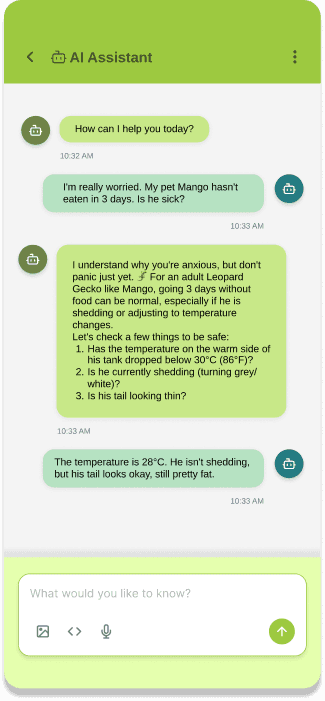
Chat with an AI Expert agent
Chat with an AI Expert agent
Chat with an AI Expert agent
Search reptile categories, Easy, Hard and danger levels
Search reptile categories
Search reptile categories, Easy/Hard/danger levels
Key Features
Key Features
Key Features
01. Research Process
01. Research Process
01. Research Process
To understand the real anxieties of beginner owners, we adopted a mixed-method approach, moving from broad quantitative data to deep qualitative insights.
To understand the real anxieties of beginner owners, we adopted a mixed-method approach, moving from broad quantitative data to deep qualitative insights.
To understand the real anxieties of beginner owners, we adopted a mixed-method approach, moving from broad quantitative data to deep qualitative insights.
5
Target User INterview
Explore user needs
5
Sections of Affinity Diagramming
Synthesized via Affinity Map
22
Quantitstive Survey
Reptile Owners Quantified
6
Usability Test
Feedbacks
5
5
Target User INterview
Target User INterview
Explore user needs
Explore user needs
5
5
Sections of Affinity Diagramming
Sections of Affinity Diagramming
Synthesized via Affinity Map
Synthesized via Affinity Map
22
22
Quantitstive Survey
Quantitstive Survey
Reptile Owners Quantified
Reptile Owners Quantified
6
6
Usability Test
Usability Test
Feedbacks
Feedbacks
02. Interviews & Surveys
02. Interviews & Surveys
02. Interviews & Surveys
With a focus on user experience design and the importance of responsible ownership, I conducted interviews and surveys with exotic pet owners. These inquiries explored how well current resources support owners in verifying care requirements, obtaining reliable information, and addressing the emotional challenges associated with raising non-traditional species.
With a focus on user experience design and the importance of responsible ownership, I conducted interviews and surveys with exotic pet owners. These inquiries explored how well current resources support owners in verifying care requirements, obtaining reliable information, and addressing the emotional challenges associated with raising non traditional species.
With a focus on user experience design and the importance of responsible ownership, I conducted interviews and surveys with exotic pet owners. These inquiries explored how well current resources support owners in verifying care requirements, obtaining reliable information, and addressing the emotional challenges associated with raising non-traditional species.
Understand what motivates beginners to adopt exotic pets and the specific emotional hurdles they face post-acquisition.
Determine the specific usability challenges owners encounter when searching for reliable husbandry information online.
Investigate the obstacles that prevent owners from accessing specialized veterinary care and community support.
Assess how well a digital solution could facilitate better health management and reduce the "fear of failure" for new owners.
Understand what motivates beginners to adopt exotic pets and the specific emotional hurdles they face post-acquisition. Determine the specific usability challenges owners encounter when searching for reliable husbandry information online. Investigate the obstacles that prevent owners from accessing specialized veterinary care and community support. Assess how well a digital solution could facilitate better health management and reduce the "fear of failure" for new owners.
Understand what motivates beginners to adopt exotic pets and the specific emotional hurdles they face post-acquisition.
Determine the specific usability challenges owners encounter when searching for reliable husbandry information online.
Investigate the obstacles that prevent owners from accessing specialized veterinary care and community support.
Assess how well a digital solution could facilitate better health management and reduce the "fear of failure" for new owners.
Goal
Goal
Key findings from the survey highlighted that lack of specialized veterinary care and conflicting information sources are the most common avenues for anxiety, followed by difficulties in environmental regulation (temperature/humidity). Significant negative emotions are most often triggered by sudden illness and the inability to interpret animal behavior. Despite these findings, owners reported a strong desire for systematic guidance, citing a lack of centralized knowledge bases and challenges in distinguishing expert advice from social noise. These insights will inform future iterations of the app, aiming to better meet owner needs for trustworthy guidance and emotional reassurance.
Key findings from the survey highlighted that lack of specialized veterinary care and conflicting information sources are the most common avenues for anxiety, followed by difficulties in environmental regulation (temperature/humidity). Significant negative emotions are most often triggered by sudden illness and the inability to interpret animal behavior. Despite these findings, owners reported a strong desire for systematic guidance, citing a lack of centralized knowledge bases and challenges in distinguishing expert advice from social noise. These insights will inform future iterations of the app, aiming to better meet owner needs for trustworthy guidance and emotional reassurance.
Key findings from the survey highlighted that lack of specialized veterinary care and conflicting information sources are the most common avenues for anxiety, followed by difficulties in environmental regulation (temperature/humidity). Significant negative emotions are most often triggered by sudden illness and the inability to interpret animal behavior. Despite these findings, owners reported a strong desire for systematic guidance, citing a lack of centralized knowledge bases and challenges in distinguishing expert advice from social noise. These insights will inform future iterations of the app, aiming to better meet owner needs for trustworthy guidance and emotional reassurance.
Interview (6 target users)
Interview (6 target users)
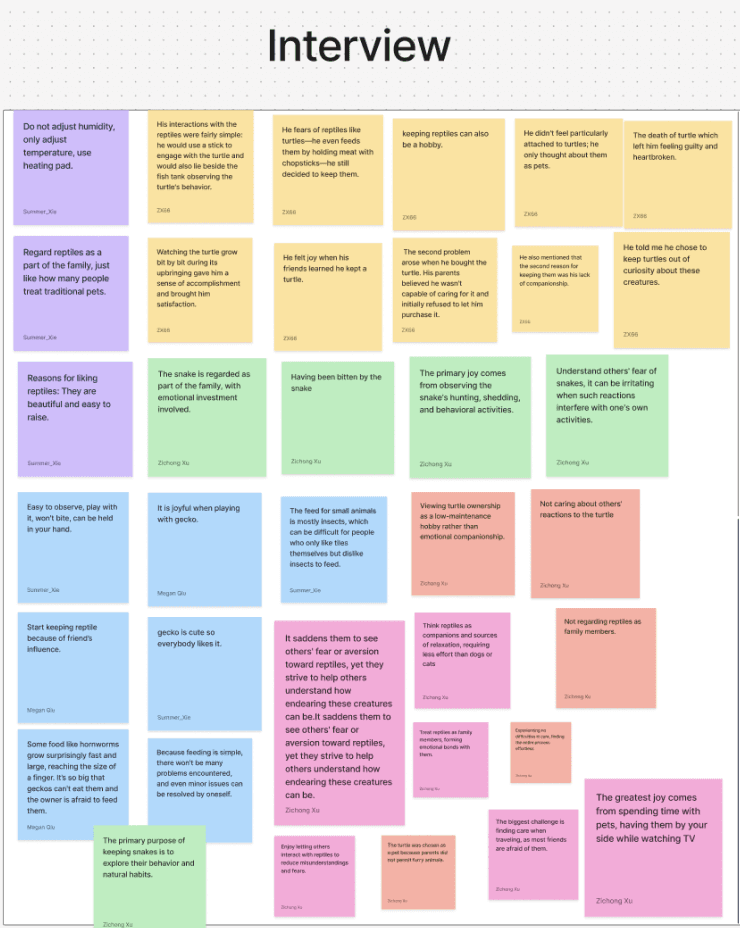
We synthesized open-ended responses to map the emotional landscape. The data reveals a cycle of anxiety driven by uncertainty
We synthesized open-ended responses to map the emotional landscape. The data reveals a cycle of anxiety driven by uncertainty
We synthesized open-ended responses to map the emotional landscape. The data reveals a cycle of anxiety driven by uncertainty
.
.
The "Vet Void" Despair
The "Vet Void" Despair
"I searched every clinic but none had experience." Owners feel intense helplessness and guilt when medical emergencies arise, fearing they are failing their pets.
"I searched every clinic but none had experience." Owners feel intense helplessness and guilt when medical emergencies arise, fearing they are failing their pets.
"I searched every clinic but none had experience." Owners feel intense helplessness and guilt when medical emergencies arise, fearing they are failing their pets.
The "Silent" Stress
The "Silent" Stress
Unlike dogs, reptiles lack obvious pain signals. Owners live in constant fear of "missing a sign" until it's too late.
Unlike dogs, reptiles lack obvious pain signals. Owners live in constant fear of "missing a sign" until it's too late.
Unlike dogs, reptiles lack obvious pain signals. Owners live in constant fear of "missing a sign" until it's too late.
Moments of Joy
Moments of Joy
Despite the anxiety, profound joy comes from small wins: a pet recognizing a hand, or educating others to replace fear with curiosity.
Despite the anxiety, profound joy comes from small wins: a pet recognizing a hand, or educating others to replace fear with curiosity.
Despite the anxiety, profound joy comes from small wins: a pet recognizing a hand, or educating others to replace fear with curiosity.
Survey (22 replies)
Survey (22 replies)
21 Questions Analyzed
21 Questions Analyzed
1. User Profile (Q1-4)
1. User Profile (Q1-4)
Q1. Owner?
Q1. Owner?
95.5%owner
95.5%owner
Q2. Type
Q2. Type
50% Turtles, 50% Lizards, 54.5% Snakes, 27.3% insect
50% Turtles, 50% Lizards, 54.5% Snakes, 27.3% insect
Q3. Experience
Q3. Experience
Average Level: ~1year
Average Level: ~1year
Q4. Learning Resources
Q4. Learning Resources
86.4% Online, 77.3% Friends or other keepers, 63.6% Pet Store, 22.7% books
86.4% Online, 77.3% Friends or other keepers, 63.6% Pet Store, 22.7% books
2. Challenges & Emotions (Q5-11)
2. Challenges & Emotions (Q5-11)
Top Difficulties (Q5, Q9)
Top Difficulties (Q5, Q9)
Lack of Care Methods
Lack of Care Methods
Lack of Care Methods
Critical
Critical
Environment Control
Environment Control
Environment Control
High
High
Emotional Impact (Q8, Q10, Q11)
Emotional Impact (Q8, Q10, Q11)
Guilt
Guilt
Helplessness
Helplessness
Fear
Fear
"Most are triggered by not finding a vet when pet is sick."
"Most are triggered by not finding a vet when pet is sick."
Q6. Reasons: 77.3% Companionship, 68.2% Enjoy observing them, 54.5% Interest/hobby, 31.8% collecting or breeding
Q6. Reasons: 77.3% Companionship, 68.2% Enjoy observing them, 54.5% Interest/hobby, 31.8% collecting or breeding
Q6. Reasons: 77.3% Companionship, 68.2% Enjoy observing them, 54.5% Interest/hobby, 31.8% collecting or breeding
Q7. Relationship: Family Member
Q7. Relationship: Family Member
Q7. Relationship: Family Member
3. Laws & Ethics (Q12-15)
3. Laws & Ethics (Q12-15)
Q12. Legal Knowledge
Q12. Legal Knowledge
Low
Low
Q15. If you no longer want to keep your animals
Q15. If you no longer want to keep your animals
54.5% continue keeping, 40.9% Giving or selling to others
54.5% continue keeping, 40.9% Giving or selling to others
4. Financing (Q16-18)
4. Financing (Q16-18)
Q18. Habit Change
Q18. Habit Change
Almost half people didn’t change their habit
Almost half people didn’t change their habit
Q17. Source
Q17. Source
Job / Parents
Job / Parents
Q16. Monthly Spend
Q16. Monthly Spend
$10 - $50
$10 - $50
5. Product Needs (Q19-20)
5. Product Needs (Q19-20)
Q19. Purchase Intent
Q19. Purchase Intent
Cute
Cute
Unique
Unique
Gentle
Gentle
Q20. Desired Features
Q20. Desired Features
Feeding Knowledge
Feeding Knowledge
Health Reminders
Health Reminders
Legal Info
Legal Info
Insights
Insights
03. Synthesizing Data
03. Synthesizing Data
03. Synthesizing Data
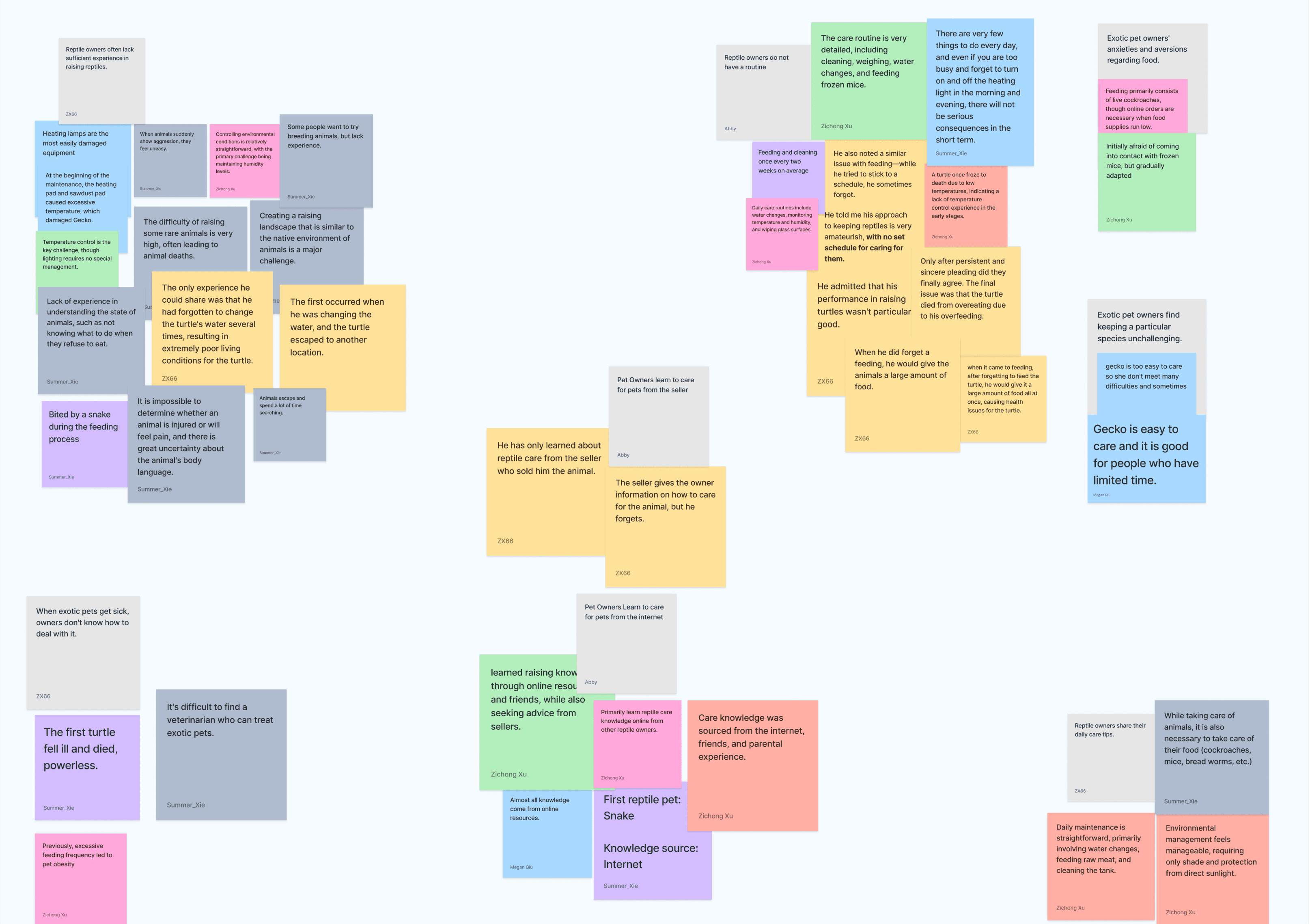
We categorized hundreds of data points into 5 core themes to identify the root causes of user anxiety.
Challenges & Pain Points
Health & Medical Issues
Knowledge Acquisition Channels
Daily Routine & Feeding Habits
Convenience & Low Maintenance
We categorized hundreds of data points into 5 core themes to identify the root causes of user anxiety.
Challenges & Pain Points
Health & Medical Issues
Knowledge Acquisition Channels
Daily Routine & Feeding Habits
Convenience & Low Maintenance
We categorized hundreds of data points into 5 core themes to identify the root causes of user anxiety.
Challenges & Pain Points
Health & Medical Issues
Knowledge Acquisition Channels
Daily Routine & Feeding Habits
Convenience & Low Maintenance
Knowledge Acquisition Channels
Knowledge Acquisition Channels
Knowledge Acquisition Channels
Challenges & Pain Points
Challenges & Pain Points
Daily Routine & Feeding Habits
Convenience & Low Maintenance
Health & Medical Issues
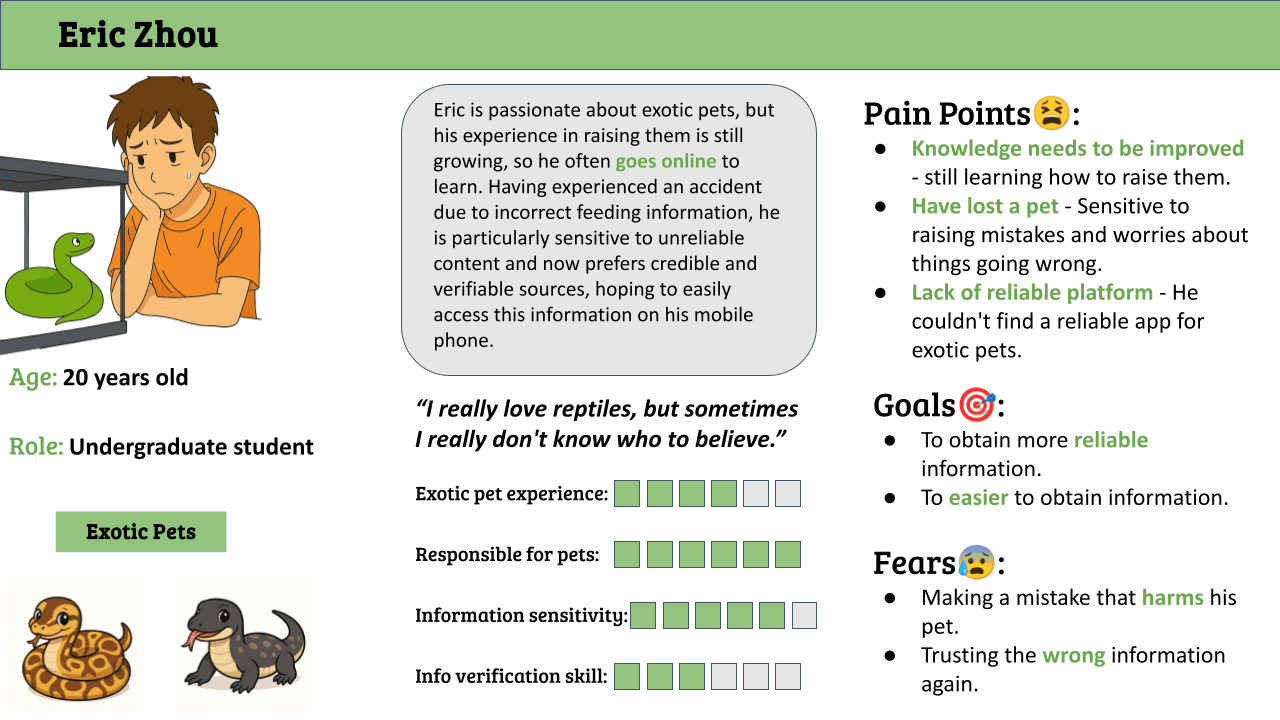
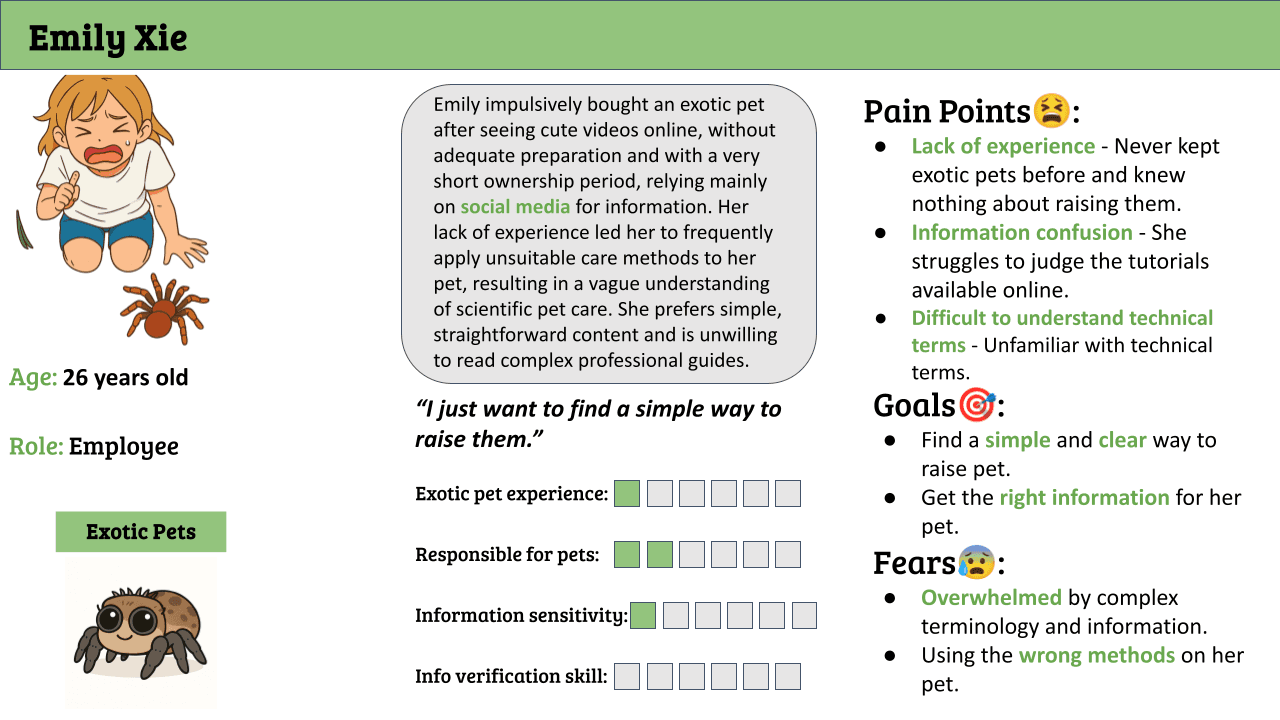
04. Persona
04. Persona
05. Defining the Problem
05. Defining the Problem
User Needs Statement
User Needs Statement
User Needs Statement
Exotic pet owners need clear, systematic care guidance, as
beginners often rely on fragmented advice, leading to errors
that can harm their pets.
Exotic pet owners need clear, systematic care guidance, as
beginners often rely on fragmented advice, leading to errors
that can harm their pets.
Exotic pet owners need clear, systematic care guidance, as beginners often rely on fragmented advice, leading to errors that can harm their pets.
Point of View (POV)
Point of View (POV)
Point of View (POV)
Owners need access to trustworthy information on how
to care for their pets safely, because most sources online
aren’t written by verified experts.
Owners need access to trustworthy information on how
to care for their pets safely, because most sources online
aren’t written by verified experts.
Owners need access to trustworthy information on how to care for their pets safely, because most sources online aren’t written by verified experts.
How Might We...
How Might We...
02
02
How might we consolidate scattered knowledge into an intuitive learning path?
How might we consolidate scattered knowledge into an intuitive learning path?
01
01
How might we help beginners understand the weight of responsibility before adopting?
How might we help beginners understand the weight of responsibility before adopting?
03
03
How can we provide immediate assistance when owners encounter difficulties?
How can we provide immediate assistance when owners encounter difficulties?
04
04
How might we help owners quickly distinguish expert advice from social noise?
How might we help owners quickly distinguish expert advice from social noise?
05
05
How might we connect owners with specific, practical answers to their problems?
How might we connect owners with specific, practical answers to their problems?
06
06
How might we create a platform ecosystem that owners can genuinely trust?
How might we create a platform ecosystem that owners can genuinely trust?
02
How might we consolidate scattered knowledge into an intuitive learning path?
01
How might we help beginners understand the weight of responsibility before adopting?
03
How can we provide immediate assistance when owners encounter difficulties?
04
How might we help owners quickly distinguish expert advice from social noise?
05
How might we connect owners with specific, practical answers to their problems?
06
How might we create a platform ecosystem that owners can genuinely trust?
06. Ideation & Structure
06. Ideation & Structure
06. Ideation & Structure
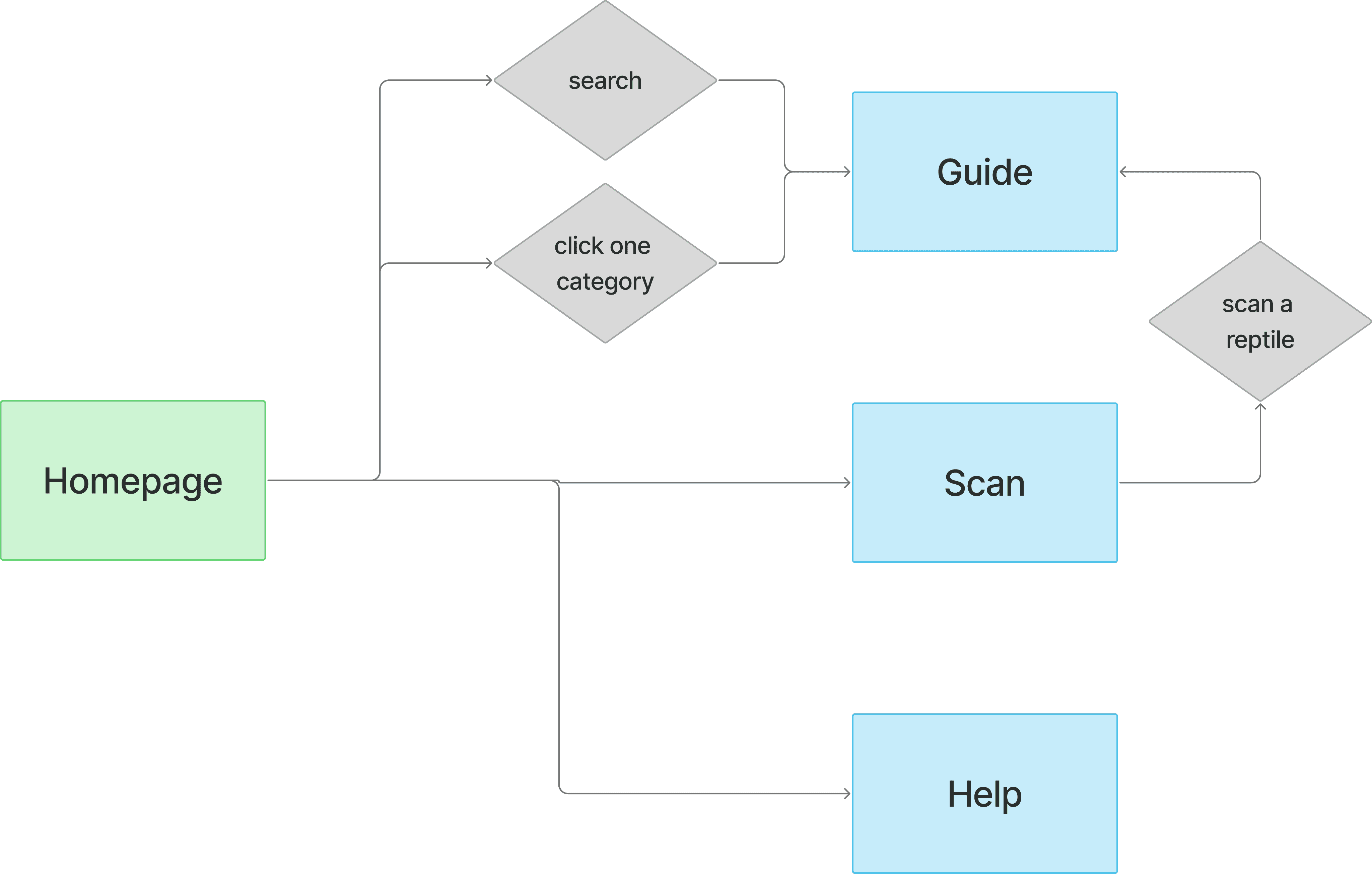
User Flow
User Flow
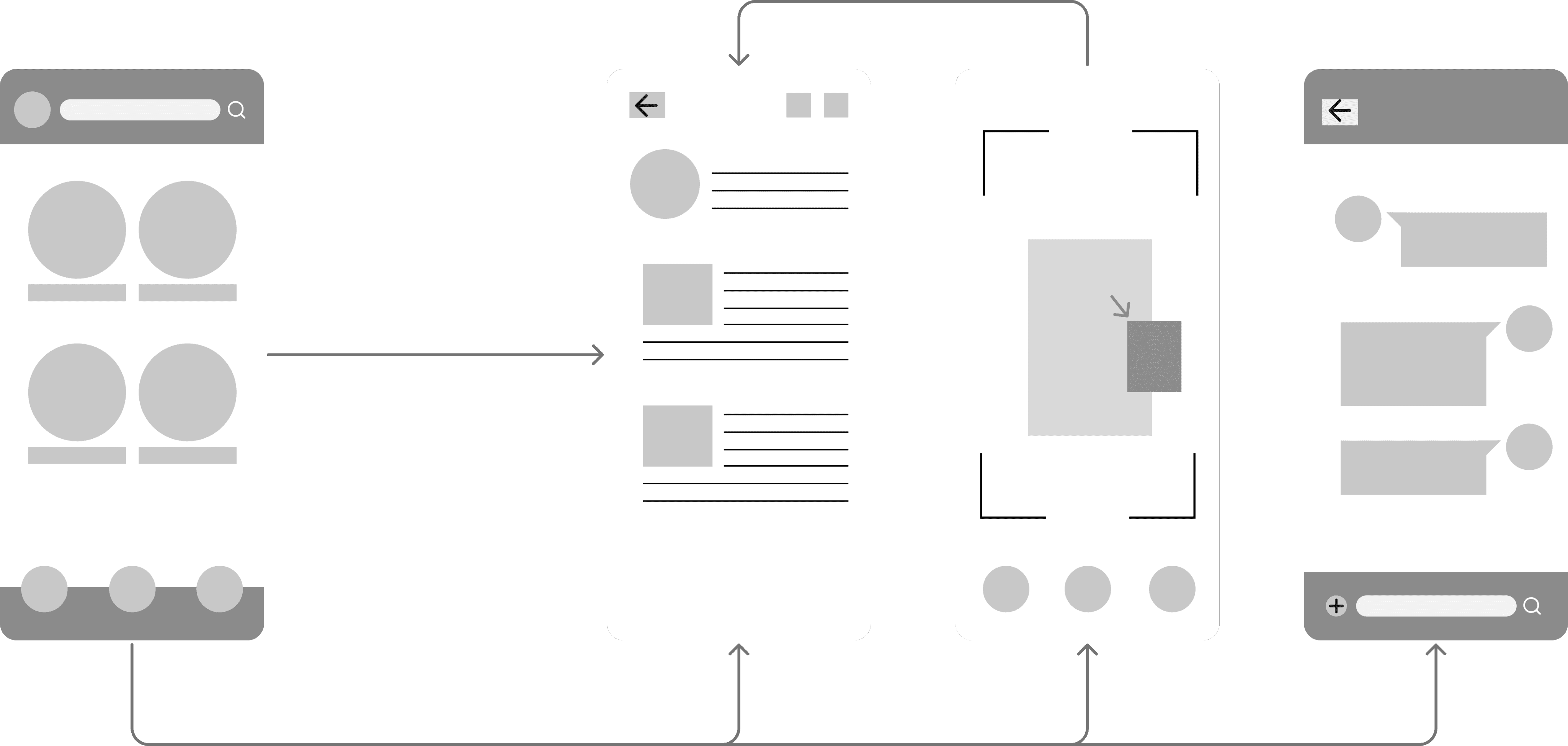
Low-Fidelity Wireframes
Low-Fidelity Wireframes
07. Usability Test & Iteration
07. Usability Test & Iteration
07. Usability Test & Iteration
We conducted in-person sessions with 5 participants, asking them to role-play as worried new pet owners. We observed how they interacted with our three core features: Types, Scan, and Help.
Test Goals
Intuitive Navigation: Can users figure out the difference between "Types" and "Scan" immediately when they are in a hurry?
Feature Clarity: Do users understand what the "Scan" function is for before they even click it?
Building Trust: On a scale of 1 to 5, how confident do users feel relying on our app's advice to treat a sick pet?
Task Success: Can users successfully find a vet or start a chat with an expert without getting stuck?
Key Findings
The testing revealed that while the concept was well-received, information overload was a major barrier. Users felt overwhelmed by dense text when they just wanted quick answers. Additionally, there was confusion distinguishing between the "live camera view" and the "static result page." However, the expert consultation feature was highly valued, with users stating it significantly reduced their fear of making the wrong medical decision. These insights drove our pivot toward a more visual-first, minimalist design.
We conducted in-person sessions with 5 participants, asking them to role-play as worried new pet owners. We observed how they interacted with our three core features: Types, Scan, and Help.
Test Goals
Intuitive Navigation: Can users figure out the difference between "Types" and "Scan" immediately when they are in a hurry?
Feature Clarity: Do users understand what the "Scan" function is for before they even click it?
Building Trust: On a scale of 1 to 5, how confident do users feel relying on our app's advice to treat a sick pet?
Task Success: Can users successfully find a vet or start a chat with an expert without getting stuck?
Key Findings
The testing revealed that while the concept was well-received, information overload was a major barrier. Users felt overwhelmed by dense text when they just wanted quick answers. Additionally, there was confusion distinguishing between the "live camera view" and the "static result page." However, the expert consultation feature was highly valued, with users stating it significantly reduced their fear of making the wrong medical decision. These insights drove our pivot toward a more visual-first, minimalist design.
Visual Principles Applied
Visual Principles Applied
Aesthetic & Minimalist
We reduced the density of text and increased the number of images to prevent "information overload," as users felt too much text ruined the visual experience.
Recognition rather than Recall
By using "business cards" with keywords (like danger levels), users can recognize important info at a glance instead of having to remember details from previous screens.
User Control
Features like the "Collection/Heart" function, "Large Image" view, and "Scrolling" give users the power to interact with the content on their own terms.
System Status
We reset the camera UI so users can clearly distinguish between the "captured photo" and the "recognized result," making the system’s actions transparent.
Consistency and Standards
The homepage was redesigned to look like a "real homepage," following modern app standards that users are already familiar with.
Heuristic Evaluation
Heuristic Evaluation
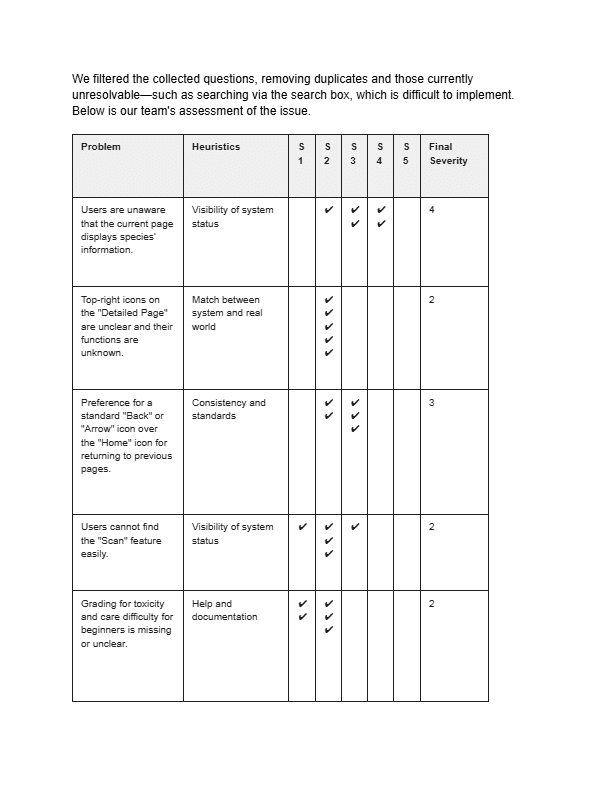
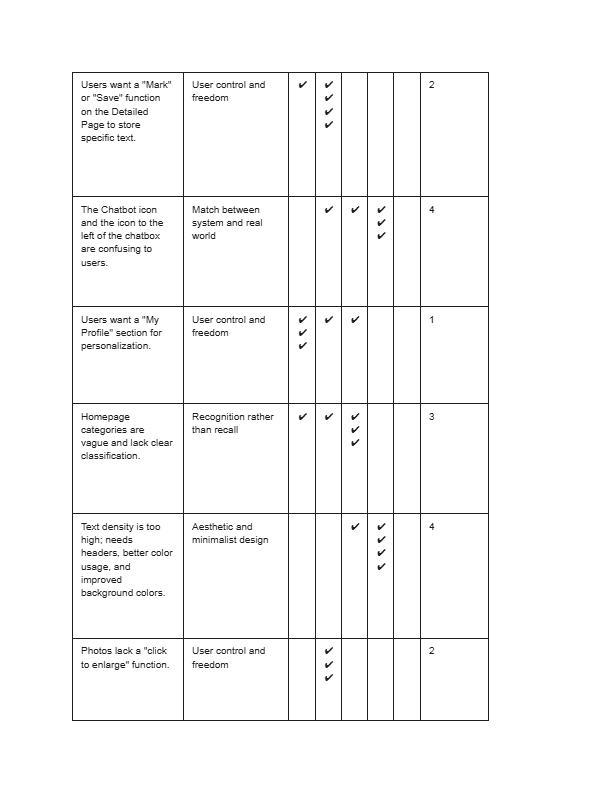
Design Rationale for Major Features
1
Species "Business Cards" & Keywords | Enhanced Interactivity
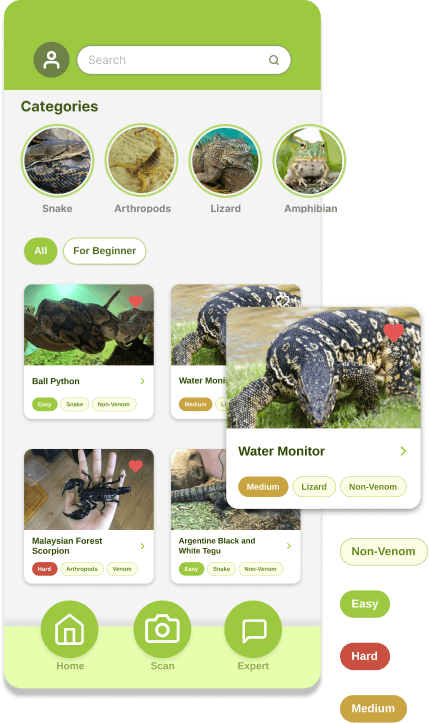
The Change: Displaying species as cards with visible keywords (e.g., danger/toxicity levels) before clicking. / Added a "Heart" icon for favorites
The Reasoning: User testing showed that people want to know the "level of danger" or "care difficulty" immediately. This design allows users to evaluate an animal quickly without needing to click into every individual page. / Users requested a "mark/save" function to keep track of animals they are interested in.
Search
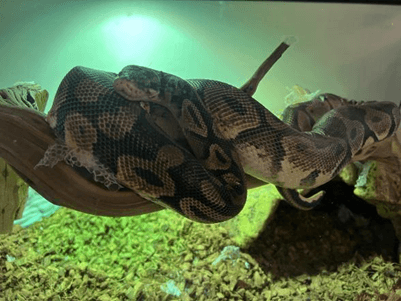
Ball Python
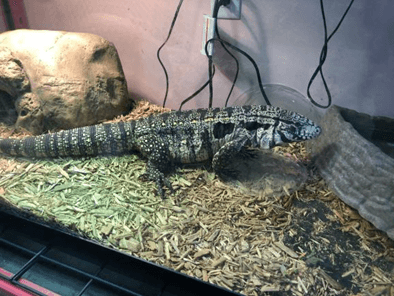
Salvator merianae
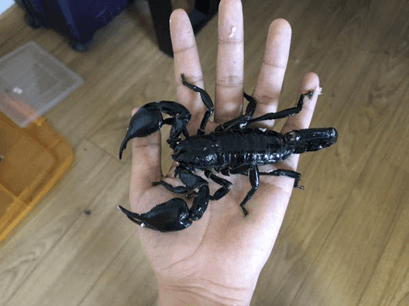
Malaysian Forest Scorpion
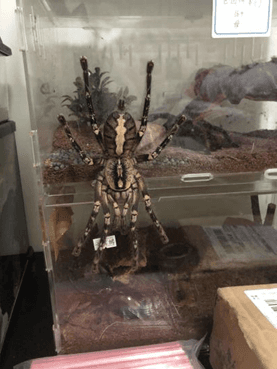
Sri Lankan Ornamental Tarantula
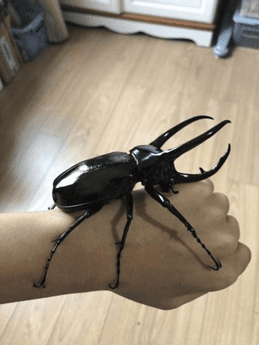
Japanese Rhinoceros Beetle
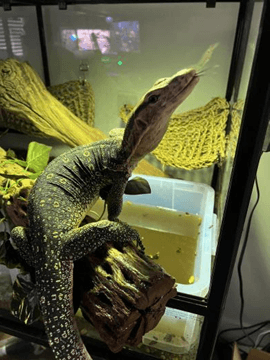
Merten’s
Water Monitor
Categories
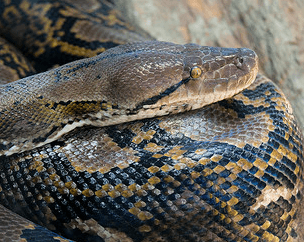
Snake
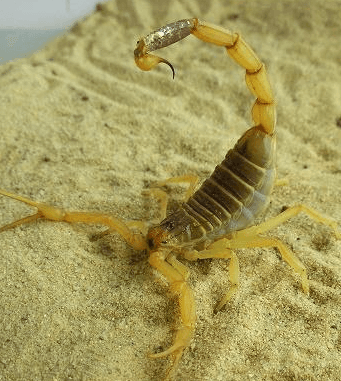
Arthropods
Lizard

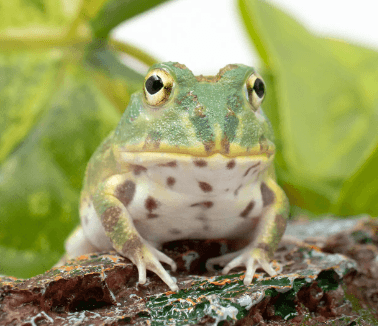
Amphibian
Search
Ball Python
Easy
Snake
Non-Venom
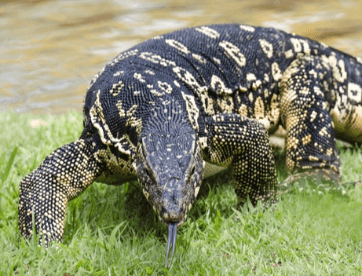
Water Monitor
Medium
Lizard
Non-Venom
Malaysian Forest
Scorpion
Hard
Arthropods
Venom
Argentine Black and White Tegu
Easy
Snake
Non-Venom
All
For Beginner
Home
Scan
Expert
Change Icons and add text to avoid confusion.
The color and font have not been thinking for accessibility.
Too simple and lacking the information that the user desires.
Use tags to let user evaluate animal quickly without clicking everytime.
Displaying species as cards with keywords
Add category “For Beginner” for new pet owner
2
Information Architecture & Classification
The Change: Moved from a flat list of species to detailed classifications and a significantly larger animal library.
The Reasoning: Users found the previous categories too vague. Adding detailed classifications and more species satisfies the user's need for a comprehensive database while making the content easier to browse.
Search
Ball Python
Salvator merianae
Malaysian Forest Scorpion
Sri Lankan Ornamental Tarantula
Japanese Rhinoceros Beetle
Merten’s
Water Monitor
Search
Categories
Home
Scan
Expert
Snake
Lizard
Arthropods
Amphibian
Ball Python
Snake
Easy
Non-Venom
Ball Python
Snake
Medium
Non-Venom
Malaysian Forest
Scorpion
Scorpion
Hard
Venom
Ball Python
Snake
Easy
Non-Venom
All
For Beginner
Snake

Non-Venom

Venom
Search
Home
Scan
Expert
Add categories to increase professional and trust
Add detailed species categories
It's inconvenient to view without categorization.
4
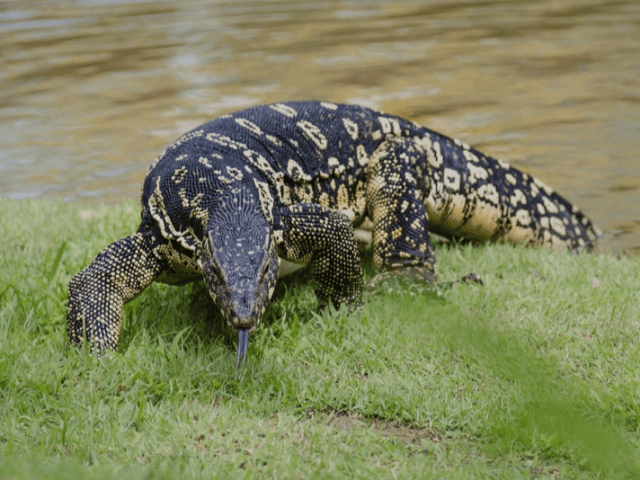
Camera UI Reset
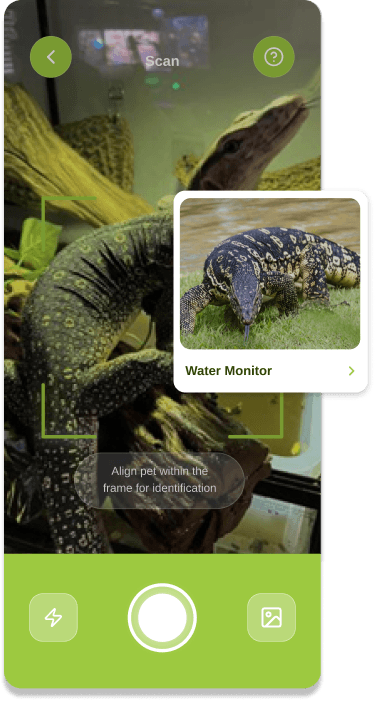
The Change: Redesigned the position of images in the camera/scan function.
The Reasoning: During testing, users were confused about which photo was the one they took and which one was the result generated by the app. This change removes that ambiguity.

Merten’s Water Monitor
Water Monitor
Align pet within the frame for identification
Scan
Change the UI to the UI common camera used to increase ease of use
Add small card with animal name instead of picture to avoid confusion.
change the “back” icon to the same one in whole app to keep consistency
3
Visual-First Content (More Pictures & Enlargement)
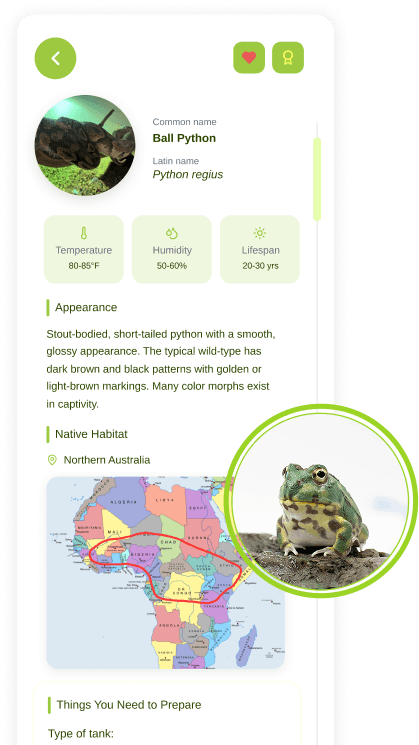
The Change: Increased the number of images in animal introductions and added a "click to enlarge" function.
The Reasoning: Users stated that too much text was overwhelming and that they wanted to see more details in the photos. Adding more visuals makes the app more engaging and useful for identification.

Latin name
Varanus mertensi
Common name
Merten’s Water Monitor
Looks:
A sleek, semi-aquatic monitor lizard with dark brown to black base coloration, scattered yellow spotting, a long muscular tail adapted for swimming, and a sharp, streamlined head.
Original from:
Southeast Asia-Northern Australia
Habits:
Semi-aquatic; excellent swimmers; active, intelligent, and curious; spends time both basking on land and diving underwater; can be skittish but may calm with consistent interaction.
Categories
Snake
Arthropods
Lizard
Amphibian
Search
Ball Python
Easy
Snake
Non-Venom
Water Monitor
Medium
Lizard
Non-Venom
Malaysian Forest
Scorpion
Hard
Arthropods
Venom
Argentine Black and White Tegu
Easy
Snake
Non-Venom
All
For Beginner
Home
Scan
Expert
Temperature
80-85°F
Humidity
50-60%
Lifespan
20-30 yrs
Appearance
Stout-bodied, short-tailed python with a smooth, glossy appearance. The typical wild-type has dark brown and black patterns with golden or light-brown markings. Many color morphs exist in captivity.
Native Habitat
Northern Australia

Common name
Ball Python
Latin name
Python regius

Home
Scan
Expert
Add click to enlarge picture function
Add “Like” and “Certification” icon
Too many texts with no key points.
Adding more visual and make important information stand out to reduce cognitive load
1
Species "Business Cards" & Keywords | Enhanced Interactivity
The Change: Displaying species as cards with visible keywords (e.g., danger/toxicity levels) before clicking. / Added a "Heart" icon for favorites
The Reasoning: User testing showed that people want to know the "level of danger" or "care difficulty" immediately. This design allows users to evaluate an animal quickly without needing to click into every individual page. / Users requested a "mark/save" function to keep track of animals they are interested in.
Search
Ball Python
Salvator merianae
Malaysian Forest Scorpion
Sri Lankan Ornamental Tarantula
Japanese Rhinoceros Beetle
Merten’s
Water Monitor
Categories
Snake
Arthropods
Lizard
Amphibian
Search
Ball Python
Easy
Snake
Non-Venom
Water Monitor
Medium
Lizard
Non-Venom
Malaysian Forest
Scorpion
Hard
Arthropods
Venom
Argentine Black and White Tegu
Easy
Snake
Non-Venom
All
For Beginner
Home
Scan
Expert
Change Icons and add text to avoid confusion.
The color and font have not been thinking for accessibility.
Too simple and lacking the information that the user desires.
Use tags to let user evaluate animal quickly without clicking everytime.
Displaying species as cards with keywords
Add category “For Beginner” for new pet owner
2
Information Architecture & Classification
The Change: Moved from a flat list of species to detailed classifications and a significantly larger animal library.
The Reasoning: Users found the previous categories too vague. Adding detailed classifications and more species satisfies the user's need for a comprehensive database while making the content easier to browse.
Search
Ball Python
Salvator merianae
Malaysian Forest Scorpion
Sri Lankan Ornamental Tarantula
Japanese Rhinoceros Beetle
Merten’s
Water Monitor
Search
Categories
Home
Scan
Expert
Snake
Lizard
Arthropods
Amphibian
Ball Python
Snake
Easy
Non-Venom
Ball Python
Snake
Medium
Non-Venom
Malaysian Forest
Scorpion
Scorpion
Hard
Venom
Ball Python
Snake
Easy
Non-Venom
All
For Beginner
Snake
Non-Venom
Venom
Search
Home
Scan
Expert
Add categories to increase professional and trust
Add detailed species categories
It's inconvenient to view without categorization.
4
Camera UI Reset
The Change: Redesigned the position of images in the camera/scan function.
The Reasoning: During testing, users were confused about which photo was the one they took and which one was the result generated by the app. This change removes that ambiguity.
Merten’s Water Monitor
Water Monitor
Align pet within the frame for identification
Scan
Change the UI to the UI common camera used to increase ease of use
Add small card with animal name instead of picture to avoid confusion.
change the “back” icon to the same one in whole app to keep consistency
3
Visual-First Content (More Pictures & Enlargement)
The Change: Increased the number of images in animal introductions and added a "click to enlarge" function.
The Reasoning: Users stated that too much text was overwhelming and that they wanted to see more details in the photos. Adding more visuals makes the app more engaging and useful for identification.
Latin name
Varanus mertensi
Common name
Merten’s Water Monitor
Looks:
A sleek, semi-aquatic monitor lizard with dark brown to black base coloration, scattered yellow spotting, a long muscular tail adapted for swimming, and a sharp, streamlined head.
Original from:
Southeast Asia-Northern Australia
Habits:
Semi-aquatic; excellent swimmers; active, intelligent, and curious; spends time both basking on land and diving underwater; can be skittish but may calm with consistent interaction.
Categories
Snake
Arthropods
Lizard
Amphibian
Search
Ball Python
Easy
Snake
Non-Venom
Water Monitor
Medium
Lizard
Non-Venom
Malaysian Forest
Scorpion
Hard
Arthropods
Venom
Argentine Black and White Tegu
Easy
Snake
Non-Venom
All
For Beginner
Home
Scan
Expert
Temperature
80-85°F
Humidity
50-60%
Lifespan
20-30 yrs
Appearance
Stout-bodied, short-tailed python with a smooth, glossy appearance. The typical wild-type has dark brown and black patterns with golden or light-brown markings. Many color morphs exist in captivity.
Native Habitat
Northern Australia
Common name
Ball Python
Latin name
Python regius
Home
Scan
Expert
Add click to enlarge picture function
Add “Like” and “Certification” icon
Too many texts with no key points.
Adding more visual and make important information stand out to reduce cognitive load
1
Species "Business Cards" & Keywords | Enhanced Interactivity
The Change: Displaying species as cards with visible keywords (e.g., danger/toxicity levels) before clicking. / Added a "Heart" icon for favorites
The Reasoning: User testing showed that people want to know the "level of danger" or "care difficulty" immediately. This design allows users to evaluate an animal quickly without needing to click into every individual page. / Users requested a "mark/save" function to keep track of animals they are interested in.
Search
Ball Python
Salvator merianae
Malaysian Forest Scorpion
Sri Lankan Ornamental Tarantula
Japanese Rhinoceros Beetle
Merten’s
Water Monitor
Categories
Snake
Arthropods
Lizard
Amphibian
Search
Ball Python
Easy
Snake
Non-Venom
Water Monitor
Medium
Lizard
Non-Venom
Malaysian Forest
Scorpion
Hard
Arthropods
Venom
Argentine Black and White Tegu
Easy
Snake
Non-Venom
All
For Beginner
Home
Scan
Expert
Change Icons and add text to avoid confusion.
Displaying species as cards with keywords
Add category “For Beginner” for new pet owner
Use tags to let user evaluate animal quickly without clicking everytime.
The color and font have not been thinking for accessibility.
Too simple and lacking the information that the user desires.
2
Information Architecture & Classification
The Change: Moved from a flat list of species to detailed classifications and a significantly larger animal library.
The Reasoning: Users found the previous categories too vague. Adding detailed classifications and more species satisfies the user's need for a comprehensive database while making the content easier to browse.
Search
Ball Python
Salvator merianae
Malaysian Forest Scorpion
Sri Lankan Ornamental Tarantula
Japanese Rhinoceros Beetle
Merten’s
Water Monitor
Search
Categories
Home
Scan
Expert
Snake
Lizard
Arthropods
Amphibian
Ball Python
Snake
Easy
Non-Venom
Ball Python
Snake
Medium
Non-Venom
Malaysian Forest
Scorpion
Scorpion
Hard
Venom
Ball Python
Snake
Easy
Non-Venom
All
For Beginner
Snake
Non-Venom
Venom
Search
Home
Scan
Expert
Add categories to increase professional and trust
Add detailed species categories
It's inconvenient to view without categorization.
4
Camera UI Reset
The Change: Redesigned the position of images in the camera/scan function.
The Reasoning: During testing, users were confused about which photo was the one they took and which one was the result generated by the app. This change removes that ambiguity.
Merten’s Water Monitor
Water Monitor
Align pet within the frame for identification
Scan
Change the UI to the UI common camera used to increase ease of use
change the “back” icon to the same one in whole app to keep consistency
Add small card with animal name instead of picture to avoid confusion.
3
Visual-First Content (More Pictures & Enlargement)
The Change: Increased the number of images in animal introductions and added a "click to enlarge" function.
The Reasoning: Users stated that too much text was overwhelming and that they wanted to see more details in the photos. Adding more visuals makes the app more engaging and useful for identification.
Latin name
Varanus mertensi
Common name
Merten’s Water Monitor
Looks:
A sleek, semi-aquatic monitor lizard with dark brown to black base coloration, scattered yellow spotting, a long muscular tail adapted for swimming, and a sharp, streamlined head.
Original from:
Southeast Asia-Northern Australia
Habits:
Semi-aquatic; excellent swimmers; active, intelligent, and curious; spends time both basking on land and diving underwater; can be skittish but may calm with consistent interaction.
Categories
Snake
Arthropods
Lizard
Amphibian
Search
Ball Python
Easy
Snake
Non-Venom
Water Monitor
Medium
Lizard
Non-Venom
Malaysian Forest
Scorpion
Hard
Arthropods
Venom
Argentine Black and White Tegu
Easy
Snake
Non-Venom
All
For Beginner
Home
Scan
Expert
Temperature
80-85°F
Humidity
50-60%
Lifespan
20-30 yrs
Appearance
Stout-bodied, short-tailed python with a smooth, glossy appearance. The typical wild-type has dark brown and black patterns with golden or light-brown markings. Many color morphs exist in captivity.
Native Habitat
Northern Australia
Common name
Ball Python
Latin name
Python regius
Home
Scan
Expert
Add click to enlarge picture function
Add “Like” and “Certification” icon
Too many texts with no key points.
Adding more visual and make important information stand out to reduce cognitive load
1
Species "Business Cards" & Keywords | Enhanced Interactivity
The Change: Displaying species as cards with visible keywords (e.g., danger/toxicity levels) before clicking. / Added a "Heart" icon for favorites
The Reasoning: User testing showed that people want to know the "level of danger" or "care difficulty" immediately. This design allows users to evaluate an animal quickly without needing to click into every individual page. / Users requested a "mark/save" function to keep track of animals they are interested in.
Search
Ball Python
Salvator merianae
Malaysian Forest Scorpion
Sri Lankan Ornamental Tarantula
Japanese Rhinoceros Beetle
Merten’s
Water Monitor
Categories
Snake
Arthropods
Lizard
Amphibian
Search
Ball Python
Easy
Snake
Non-Venom
Water Monitor
Medium
Lizard
Non-Venom
Malaysian Forest
Scorpion
Hard
Arthropods
Venom
Argentine Black and White Tegu
Easy
Snake
Non-Venom
All
For Beginner
Home
Scan
Expert




Change Icons and add text to avoid confusion.
The color and font have not been thinking for accessibility.
Too simple and lacking the information that the user desires.
Use tags to let user evaluate animal quickly without clicking everytime.
Displaying species as cards with keywords
Add category “For Beginner” for new pet owner
2
Information Architecture & Classification
The Change: Moved from a flat list of species to detailed classifications and a significantly larger animal library.
The Reasoning: Users found the previous categories too vague. Adding detailed classifications and more species satisfies the user's need for a comprehensive database while making the content easier to browse.
Search
Ball Python
Salvator merianae
Malaysian Forest Scorpion
Sri Lankan Ornamental Tarantula
Japanese Rhinoceros Beetle
Merten’s
Water Monitor
Search
Categories
Home
Scan
Expert
Snake
Lizard
Arthropods
Amphibian
Ball Python
Snake
Easy
Non-Venom
Ball Python
Snake
Medium
Non-Venom
Malaysian Forest
Scorpion
Scorpion
Hard
Venom
Ball Python
Snake
Easy
Non-Venom
All
For Beginner
Snake
Non-Venom
Venom
Search
Home
Scan
Expert



Add categories to increase professional and trust
Add detailed species categories
It's inconvenient to view without categorization.
4
Camera UI Reset
The Change: Redesigned the position of images in the camera/scan function.
The Reasoning: During testing, users were confused about which photo was the one they took and which one was the result generated by the app. This change removes that ambiguity.
Merten’s Water Monitor
Water Monitor
Align pet within the frame for identification
Scan
Change the UI to the UI common camera used to increase ease of use
Add small card with animal name instead of picture to avoid confusion.
change the “back” icon to the same one in whole app to keep consistency
3
Visual-First Content (More Pictures & Enlargement)
The Change: Increased the number of images in animal introductions and added a "click to enlarge" function.
The Reasoning: Users stated that too much text was overwhelming and that they wanted to see more details in the photos. Adding more visuals makes the app more engaging and useful for identification.
Latin name
Varanus mertensi
Common name
Merten’s Water Monitor
Looks:
A sleek, semi-aquatic monitor lizard with dark brown to black base coloration, scattered yellow spotting, a long muscular tail adapted for swimming, and a sharp, streamlined head.
Original from:
Southeast Asia-Northern Australia
Habits:
Semi-aquatic; excellent swimmers; active, intelligent, and curious; spends time both basking on land and diving underwater; can be skittish but may calm with consistent interaction.
Categories
Snake
Arthropods
Lizard
Amphibian
Search
Ball Python
Easy
Snake
Non-Venom
Water Monitor
Medium
Lizard
Non-Venom
Malaysian Forest
Scorpion
Hard
Arthropods
Venom
Argentine Black and White Tegu
Easy
Snake
Non-Venom
All
For Beginner
Home
Scan
Expert
Temperature
80-85°F
Humidity
50-60%
Lifespan
20-30 yrs
Appearance
Stout-bodied, short-tailed python with a smooth, glossy appearance. The typical wild-type has dark brown and black patterns with golden or light-brown markings. Many color morphs exist in captivity.
Native Habitat
Northern Australia
Common name
Ball Python
Latin name
Python regius
Home
Scan
Expert



Add click to enlarge picture function
Add “Like” and “Certification” icon
Too many texts with no key points.
Adding more visual and make important information stand out to reduce cognitive load
1
Species "Business Cards" & Keywords | Enhanced Interactivity
The Change: Displaying species as cards with visible keywords (e.g., danger/toxicity levels) before clicking. / Added a "Heart" icon for favorites
The Reasoning: User testing showed that people want to know the "level of danger" or "care difficulty" immediately. This design allows users to evaluate an animal quickly without needing to click into every individual page. / Users requested a "mark/save" function to keep track of animals they are interested in.
Search
Ball Python
Salvator merianae
Malaysian Forest Scorpion
Sri Lankan Ornamental Tarantula
Japanese Rhinoceros Beetle
Merten’s
Water Monitor
Categories
Snake
Arthropods
Lizard
Amphibian
Search
Ball Python
Easy
Snake
Non-Venom
Water Monitor
Medium
Lizard
Non-Venom
Malaysian Forest
Scorpion
Hard
Arthropods
Venom
Argentine Black and White Tegu
Easy
Snake
Non-Venom
All
For Beginner
Home
Scan
Expert
Change Icons and add text to avoid confusion.
The color and font have not been thinking for accessibility.
Too simple and lacking the information that the user desires.
Use tags to let user evaluate animal quickly without clicking everytime.
Displaying species as cards with keywords
Add category “For Beginner” for new pet owner
2
Information Architecture & Classification
The Change: Moved from a flat list of species to detailed classifications and a significantly larger animal library.
The Reasoning: Users found the previous categories too vague. Adding detailed classifications and more species satisfies the user's need for a comprehensive database while making the content easier to browse.
Search
Ball Python
Salvator merianae
Malaysian Forest Scorpion
Sri Lankan Ornamental Tarantula
Japanese Rhinoceros Beetle
Merten’s
Water Monitor
Search
Categories
Home
Scan
Expert
Snake
Lizard
Arthropods
Amphibian
Ball Python
Snake
Easy
Non-Venom
Ball Python
Snake
Medium
Non-Venom
Malaysian Forest
Scorpion
Scorpion
Hard
Venom
Ball Python
Snake
Easy
Non-Venom
All
For Beginner
Snake
Non-Venom
Venom
Search
Home
Scan
Expert
Add categories to increase professional and trust
Add detailed species categories
It's inconvenient to view without categorization.
4
Camera UI Reset
The Change: Redesigned the position of images in the camera/scan function.
The Reasoning: During testing, users were confused about which photo was the one they took and which one was the result generated by the app. This change removes that ambiguity.
Merten’s Water Monitor
Water Monitor
Align pet within the frame for identification
Scan
Change the UI to the UI common camera used to increase ease of use
Add small card with animal name instead of picture to avoid confusion.
change the “back” icon to the same one in whole app to keep consistency
3
Visual-First Content (More Pictures & Enlargement)
The Change: Increased the number of images in animal introductions and added a "click to enlarge" function.
The Reasoning: Users stated that too much text was overwhelming and that they wanted to see more details in the photos. Adding more visuals makes the app more engaging and useful for identification.
Latin name
Varanus mertensi
Common name
Merten’s Water Monitor
Looks:
A sleek, semi-aquatic monitor lizard with dark brown to black base coloration, scattered yellow spotting, a long muscular tail adapted for swimming, and a sharp, streamlined head.
Original from:
Southeast Asia-Northern Australia
Habits:
Semi-aquatic; excellent swimmers; active, intelligent, and curious; spends time both basking on land and diving underwater; can be skittish but may calm with consistent interaction.
Categories
Snake
Arthropods
Lizard
Amphibian
Search
Ball Python
Easy
Snake
Non-Venom
Water Monitor
Medium
Lizard
Non-Venom
Malaysian Forest
Scorpion
Hard
Arthropods
Venom
Argentine Black and White Tegu
Easy
Snake
Non-Venom
All
For Beginner
Home
Scan
Expert
Temperature
80-85°F
Humidity
50-60%
Lifespan
20-30 yrs
Appearance
Stout-bodied, short-tailed python with a smooth, glossy appearance. The typical wild-type has dark brown and black patterns with golden or light-brown markings. Many color morphs exist in captivity.
Native Habitat
Northern Australia
Common name
Ball Python
Latin name
Python regius
Home
Scan
Expert
Add click to enlarge picture function
Add “Like” and “Certification” icon
Too many texts with no key points.
Adding more visual and make important information stand out to reduce cognitive load
Design Rationale for Major Features
08. Project Outcome
08. Project Outcome
08. Project Outcome
#9DC940
#9DC940
#9DC940
#425A15
#425A15
#425A15
#E5FFAE
#E5FFAE
#E5FFAE
#F4F4F4
#F4F4F4
#F4F4F4
Reflection & Growth
In the design part, I grew by learning to use evidence-based iteration to drive my design decisions. Initially, I focused on building the app based on our research part and group assumptions, but usability testing revealed critical issues we hadn't considered. Based on these test results and design principles, I iterated the prototype, switching to a more professional "deep green" palette and establishing a clearer hierarchy to improve usability. I realized that design is not just about aesthetics, it is a process of using real feedback to create a tool users can confidently rely on. Anyway, I'm very glad to have collaborated with my classmates on this project. I really enjoyed discussing these ux strategies with the group members, features, user flows, and the iteration.
Future Roadmap
Reduce Cognitive Load: Further refine the minimalist approach to ensure information is instant and stress-free.
Community Integration: Explore features that connect beginners with vetted experts safely.
Accessibility: Ensure the app is fully usable for owners with varying visual or motor abilities.